





According to density, hardened concrete is divided into the following:
- ordinary concrete → ρ = 2000 – 2800 kg/m3
- lightweight concrete → ρ < 2000 kg/m3
- heavy concrete → ρ > 2800 kg/m3
The density of individual types of concrete depends mainly on the density of the aggregate, i.e. the filler used for concrete production, and the amount of entrained air in the concrete structure, which is achieved by special production. The appearance of the structures of individual types of concrete is shown in Figure 4.3.
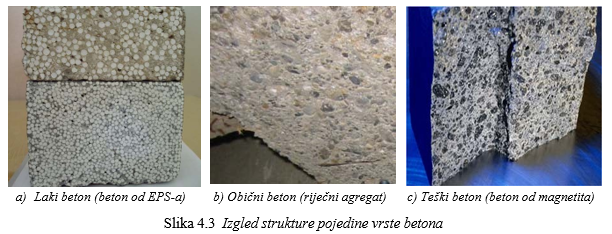
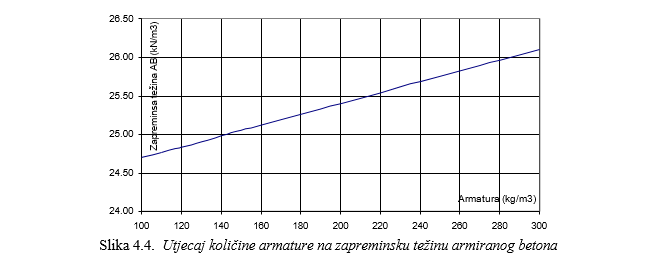
Regular concrete is the most widespread type of concrete, and most load-bearing concrete structures are made of it. This type of concrete is made from natural aggregates, which are also the cheapest raw material in concrete. Natural aggregates are obtained from extracted deposits (formed by erosion processes of various types of rocks) and/or by crushing large pieces of natural rocks. The properties of the aggregate depend on the properties of the original rock and the crushing process. In analyses and calculations of concrete structures made of regular concrete, it is assumed that the density of unreinforced concrete is ρ = 2400 kg/m3, and reinforced concrete (concrete + reinforcement) ρ = 2500 kg/m3. For simplicity, in calculations, the term volume weight of concrete is often used instead of concrete density, which, according to the previously mentioned densities, is: γc = 24 kN/m3 for unreinforced concrete and γc = 25 kN/m3 for reinforced concrete (concrete + reinforcement). The volume weight of reinforced concrete depends on the amount of reinforcement. Some elements can have a high percentage of reinforcement with longitudinal and transverse steel reinforcement, and thus a higher volume weight, as seen in Figure 4.4.
The amount of steel reinforcement in individual structural elements in construction is mostly:
- for strip foundations and foundation beams ≈ 60-80 kg/m3 of concrete
- for ceiling slabs ≈ 80-100 kg/m3 of concrete
- for walls ≈ 100-120 kg/m3 of concrete
- for foundation plates ≈ 80-110 kg/m3 of concrete
- for columns and beams ≈ 120-140 kg/m3
Generally, the amount of reinforcement in load-bearing reinforced concrete structures in construction is 100-110 kg/m3 of concrete. If we look at the diagram in Figure 4.4, for structural elements with an amount of reinforcement less than 145 kg/m3, the bulk weight of reinforced concrete is less than γc = 25 kN/m3, which is consistent with the amount of steel reinforcement in structural elements in construction.
Lightweight concretes are divided into the following: lightweight aggregate concretes, concretes with equal-grained aggregate, and cellular concretes. The reduction in density is always achieved by creating pores in the aggregate or creating spaces between the coarse grains of the aggregate or pores in the cement paste. It is understandable that the creation of pores in concrete reduces its properties in terms of strength and abrasion resistance compared to regular concrete. However, lightweight concretes have other advantages compared to regular concrete, such as better thermal and acoustic insulation properties, porosity, and lower bulk weight. Production is also slightly more expensive, and production and installation generally require a slightly greater commitment to achieve the desired properties.
In construction, the most widely used are lightweight aggregate concretes, which are obtained on the basis of cement, water, lightweight aggregates, and possibly additives. These aggregates can be of inorganic (perlite, vermiculite, crushed brick, keramzit, etc.) or organic origin (wood shavings, wood wool, EPS, etc.).
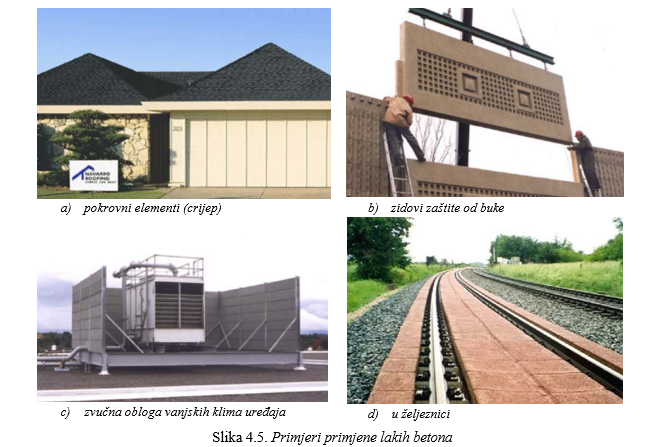
Lightweight aggregate concretes are used for the production of various panels and blocks, roofing elements, floor bases, final floor layers, as well as structural elements. The application area of lightweight concretes depends on their density. Lightweight concretes with a density of ρ < 800 kg/m3 are used as thermal insulation elements, while for structural elements, lightweight concretes with a density of ρ < 1400 kg/m3 can be used.
Lightweight concretes with equal-grained aggregate are obtained by omitting finer aggregate grains and using almost one fraction of nominally the same grain size. These concretes are resistant to freezing due to the increased structure, as they practically do not have capillary pores. In addition, this concrete absorbs sound well, so it is used for lining rooms where acoustic conditions are crucial.
The most well-known cellular concretes are gas concrete and foam concrete. They are produced by a special process from cement, lime, fly ash, and quartz sand in such a way that at high temperatures, the pozzolanic reactions of fly ash and quartz sand are activated and accelerated, and at the same time, special additives are added that cause gas expansion and create a cellular structure. The most well-known in construction are Ytong and Siporex, which are used as insulation, but also as structural elements.
A large radiation shielding mass of heavy concrete is achieved by using heavy aggregates, such as barite, iron ores (magnetite, hematite, and limonite), punchings or specially made iron and steel balls. To improve the shielding properties of heavy concretes, boron or lithium compounds are added to them. The strength of heavy concretes is not high, the compressive strength does not exceed 40 MPa, while the tensile strengths range from 1 to 3 MPa. The reason is that the strength of the cement stone (paste) is significantly lower than the strength of the heavy aggregate, so the fracture line goes through the cement stone and bypasses the aggregate grains.
Heavy concretes are used for radiation protection in nuclear power plants, radiation protection in hospitals (X-ray rooms, cobalt bombs, etc.), foundations of heavy machinery, and as ballast for ship stabilization.