





Thermal insulation of a house represents one of the most important factors in modern construction. In conditions of climate change, with increasingly large temperature oscillations and constant increases in energy prices, quality thermal insulation is not just a recommendation – it is a necessity. In Bosnia and Herzegovina, where winters can be exceptionally cold and summers increasingly hot, properly designed and implemented insulation directly affects the quality of life, heating and cooling costs, and the long-term value of the property.
In this ultra-detailed guide, you will learn everything you need to know about thermal insulation: from the basic principles of building physics, through the choice of materials, to concrete prices in KM and practical advice from construction sites.
Basic Principles of Thermal Insulation
Heat always moves from a warmer to a cooler space. In the winter period, heat escapes from the house to the outside, while in the summer period, heat enters the building. The goal of insulation is to slow down this process and minimize losses.
Heat transfer occurs through three basic mechanisms:
- Conduction – transfer of heat through a material
- Convection – transfer through air movement
- Radiation – transfer by radiation
A well-designed insulation must take into account all three processes.
Coefficient of Heat Transfer (U-value)
The U-value represents the amount of heat that passes through a particular building element. The smaller the value, the better the insulation.
Examples:
- Uninsulated wall: 1.5 – 2.0 W/m²K
- Standard insulation: 0.30 – 0.40 W/m²K
- Energy-efficient wall: 0.20 W/m²K
- Passive house: < 0.15 W/m²K
Legal regulations in the region require increasingly lower U-values, which means that the future is in thicker and higher-quality insulation layers.
Types of Thermal Insulation Materials
EPS (Styrofoam)
EPS is the most represented insulation material in Bosnia and Herzegovina. Its popularity stems from its excellent price-performance ratio.
Prices in KM:
- 5 cm: 6 – 7 KM/m²
- 8 cm: 9 – 11 KM/m²
- 10 cm: 12 – 14 KM/m²
- 15 cm: 18 – 22 KM/m²
Advantages:
- Affordable price
- Easy processing
- Good insulation properties
Disadvantages:
- Poor fire resistance
- Limited vapor permeability
Mineral Wool
Mineral wool is a high-quality insulation material used when maximum performance is required.
Prices:
- Material: 50 – 80 KM/m²
- Complete system: 75 – 110 KM/m²
Its greatest advantage is non-flammability and excellent sound insulation.
XPS (Styrofoam)
XPS is used in areas of high humidity and load.
- Price: 60 – 90 KM/m²
Graphite Styrofoam
An advanced version of EPS with better insulation properties.
Price: 15–25 KM/m²
Insulation of External Walls (ETICS System)
The ETICS system is a standard in modern construction. It consists of several layers that together form a functional whole.
- Adhesive
- Insulation
- Mechanical fasteners
- Reinforcement mesh
- Final layer
Price of the complete system in Bosnia and Herzegovina:
- 80 – 130 KM/m²
The thickness of the insulation directly affects performance. Today, a minimum of 10 cm is recommended, while 15–20 cm is optimal.
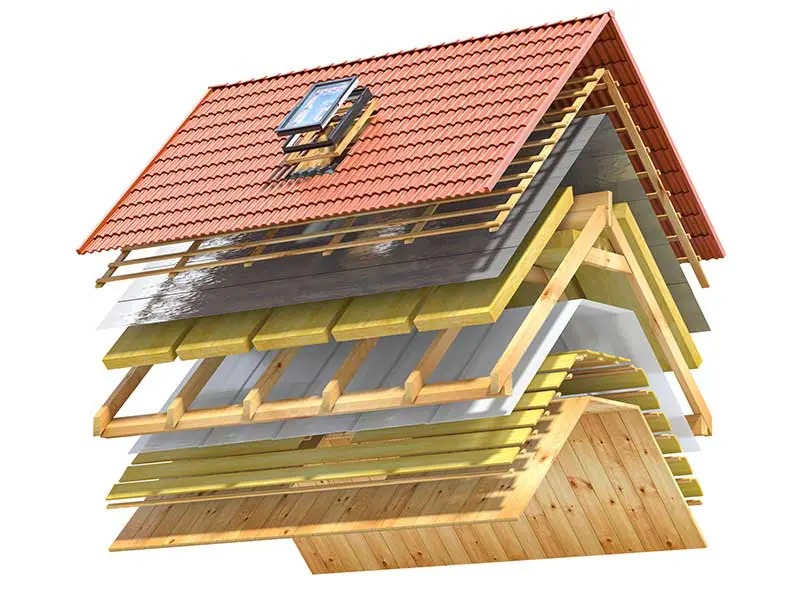
Insulation of Roofs and Attics
The roof is one of the largest sources of heat loss. Without adequate insulation, up to 30% of energy is lost through the roof.
Mineral or glass wool is most commonly used.
- Thickness: 20 – 30 cm
- Price: 30 – 70 KM/m²
Proper ventilation of the roof is crucial to prevent condensation.
Insulation of Floors
Floors in the basement must have thermal insulation due to direct contact with the ground.
- XPS: 5 – 10 cm
- Price: 40 – 100 KM/m²
How to Choose the Best Insulation
Thermal Bridges
Thermal bridges are critical points where increased heat loss occurs.
- Balconies
- Parapets
- Window frames
Their solution requires precise design and execution.
Detailed Example of House Costs (150 m²)
- Facade: 12,000 – 18,000 KM
- Roof: 4,000 – 8,000 KM
- Floor: 3,000 – 6,000 KM
Total: 19,000 – 32,000 KM
Return on Investment
Investment in insulation returns through energy savings.
- Savings: 30 – 60%
Most Common Mistakes in Practice
- Insufficient insulation thickness
- Poor installation
- Low-quality materials
- Disruption of the insulation layer
The choice depends on the budget, type of object, and desired performance.
- Budget option: EPS
- Middle class: graphite EPS
- Premium: mineral wool
Energy Efficiency and Future
Energy-efficient buildings are becoming a standard. In the future, insulation will play an even more important role due to increasingly stricter regulations.
Conclusion
Thermal insulation of a house is one of the most important investments in construction. With the right choice of material and quality execution, significant savings, increased comfort, and extended building lifespan can be achieved.
Regardless of the budget, investing in insulation always pays off.