





In low-rise construction, earthworks are very extensive. In high-rise construction, earthworks can be mainly divided into excavations, excavations, and embankments.
The execution of individual types of earthworks differs according to the type of earth material (different types of materials require different types of tools and machines for execution).
We classify the soil in two ways: according to construction norms and according to the needs for foundation.
The categories of land with respect to earthworks and construction norms are:
A category - includes solid materials that require mining of the entire excavation. This group includes all types of solid and healthy rocks / eruptive, metamorphic and sedimentary / including possible thinner layers of loose material as well as soils with more than 50% of boulders larger than 0.5 m3 for which mining is required.
B category - includes semi-solid stone soils where partial mining is required, and the rest of the excavation is done by direct machine work. This group includes homogeneous marl, flysch materials, weathered sandstones, a mixture of marl and sandstone, most dolomites, all types of schist, crushed limestones, decomposed rocks on the surface, some conglomerates, and similar materials.
C category - includes all materials that do not need to be mined but can be dug directly using a bulldozer, excavator, or scraper. This category includes:
- fine-grained / bound / coherent soils - clays, dusty clays / loams /, dust, sandy dust, and loess,
- coarse-grained unbound / non-coherent soils such as sand, gravel or their mixtures, natural stone screenings, etc.
- mixed soils - which are a mixture of coarse-grained unbound and fine-grained unbound
Categorization according to the needs for foundation is divided into:
- natural soils - divided into five categories (rocks, unbound materials, bound materials, silts, and peat)
- filled soils - homogeneous (compacted) and non-homogeneous (uncompacted)

We distinguish between two types of excavations:
- Wide excavation (mostly for basement spaces or roads)
- Narrow excavation (mostly for wall foundations and channels)
Works for excavations and excavations include: digging, breaking, mining, and transporting earthworks. Works for embankments include: compaction, planning, and rolling of materials
PROTECTIONOF EXCAVATIONSIDES from collapse is achieved by:
- inclining the sides at an angle of natural slope
- taking over the earth pressure with special auxiliary structures
WIDE EXCAVATIONS are performed wider than the building contour by 1 - 1.5 m, so that normal work is enabled from the outside - for the basement part. Securing such excavations is done by supporting or anchoring. A completed and arranged excavation in a wide sense is also called a construction pit.
For excavations deeper than 2 m, the side walls are made with a slope, and if there is no room for them, then in category II and III soils, up to a depth of 2 m, steeper slopes can be left, which must be secured with a lining held by columns, and they are supported by struts. To prevent rainwater from being retained in the construction pit, it is necessary to dig a collection pit at a suitable location and install a pump for pumping water out of the pit.

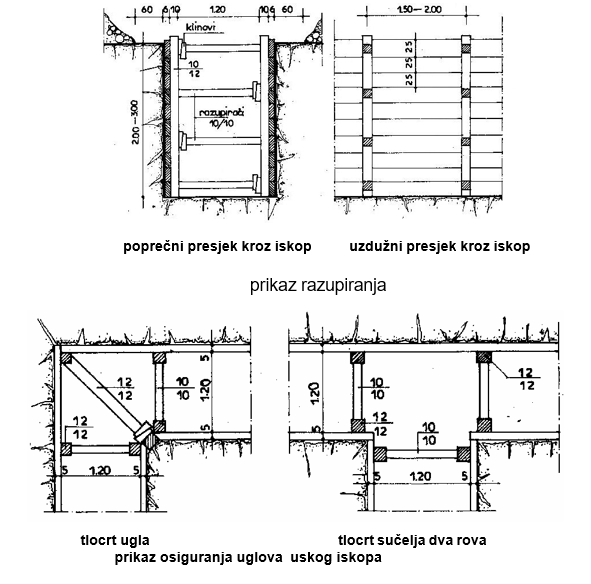
Narrow excavations are necessary for strip foundations of buildings. Securing of such excavations is done by shoring. When excavating, special attention should be paid to the places where narrow excavations (trenches) meet, as security is necessary in both directions. Vertical walls of excavations for foundations with depths of 1.5 to 2.0 m are shored in the top third of the depth. Protection of the sides in greater depths is combined with platforms for soil removal. The deeper the excavation, the greater the security.
PROTECTION OF EXCAVATED CONSTRUCTION PITS WITH SLOPES. By excavating or mining sloping terrain, larger or smaller height differences are created between the ground in the excavation and the natural ground outside the excavation. Potential landslides under the natural ground should be prevented by building a retaining wall (masonry work) or by creating a slope at an angle at which no landslide will occur (earthwork).
According to our regulations, the following steepest slopes are allowed:
Slopes of the slope for land of category C for excavations deeper than 3 m is up to 1:1.5 (350), and for depths below 3 m the slope is up to 1:1 (450)
For land of category B, the slope is up to 1:0.5 (630), and for land of category A up to 1:0.75 (760).
Depending on the type of soil, slopes can be humusated, sown or planted, which protects, consolidates and beautifies their surface.
In order to perform earthworks, and later other construction works, it is necessary to lower the groundwater level (GWL) below the bottom of the construction pit. This is achieved by pumping water and preventing inflow in several ways:
- If it is a small inflow, GWL can be pumped directly from the construction pit (through a window with a lower bottom) or from wells dug around the construction pit, into which GWL then flows due to the difference in levels – groundwater behaves in the soil according to the law of connected vessels, but with a certain retardation due to soil resistance.
- Special devices that simultaneously pump water and set up a barrier to further GWL inflow into the construction pit are called vacuum pumps with needle filters.

3. In-situ barriers (are made) from steel sheet piles, concrete structures, soil freezing and geotextiles. In-situ barriers significantly slow down but do not prevent water flow, so it is necessary to have initial and periodic or constant pumping during operation. In-situ barriers are calculated similarly to retaining structures (shores) in excavations, depending on soil and water pressure and the static scheme.