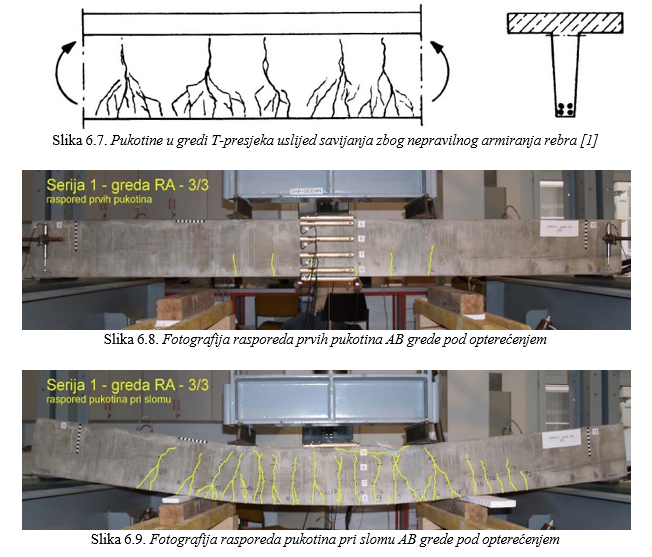
In reinforced concrete structures, cracks in the concrete can often not be avoided. In addition to the aforementioned causes of concrete cracking, stresses caused by forced deformations that occur during settlement of bearings and rotation of support points, and deformations of connection elements due to linear temperature differences, can also lead to crack formation. Therefore, a general classification based on the causes of occurrence can be given:
Concrete shrinkage: Cracks caused by concrete shrinkage are of a plastic consistency and occur immediately after concreting. These are longitudinal cracks that form most frequently on the upper surface of the placed reinforcement along its length.
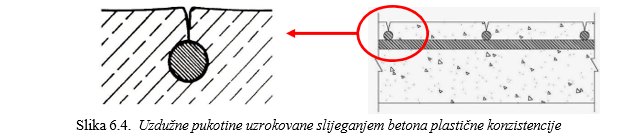
The formation of this type of cracking can be prevented by the proper composition of concrete, as well as by appropriate installation measures, such as installation in multiple layers, concrete care, etc.
Prevention of volume change: These types of cracks are caused by concrete shrinkage or temperature changes and can be divided into two groups according to the time of formation:
a) Cracks that occur shortly after concreting: These cracks occur a few days after concreting. They occur due to temperature differences between the concrete (the temperature of the concrete usually reaches values of 40 to 50°C due to hydration) and the environment, and the still insufficiently developed tensile strength of the concrete. In the case of thick plates or walls, due to the prevention of shrinkage, so-called grid cracks occur. This type of crack is prevented by proper concrete care and limited by a surface layer of reinforcement, which would take over the tensile stresses instead of the concrete.
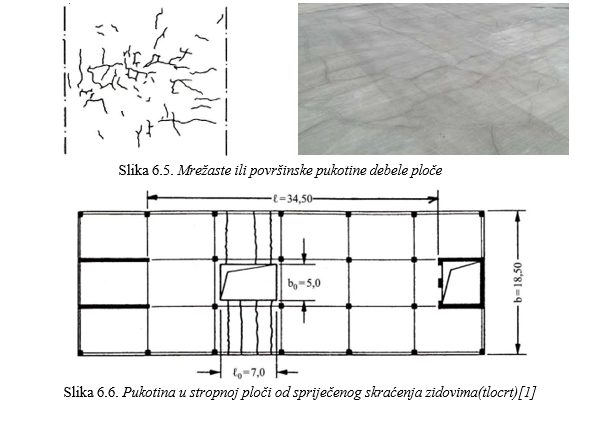
b) Cracks that occur due to shrinkage caused by concrete drying: These cracks occur due to drying after several months from the time of concreting or due to temperature changes during use. They have the same appearance as the cracks under a). They are prevented, or limited in the same way as under a).
Effect of loading: The cause of this type of crack is the effect of loading that causes tensile longitudinal forces, bending moments or torsion moments. All these cracks are limited by an appropriate amount of reinforcement, which is determined by calculations and careful development of reinforcement of individual details.