





Foundations are the most important structural element of every building. They transfer the load of the object to the ground and ensure stability, safety, and longevity of the construction. Without properly executed foundations, even the highest-quality walls, roofs, or installations cannot guarantee the stability of the object.
In this detailed guide, we will cover all aspects of foundations – from types, calculations, and materials, to real prices in KM and practical advice from implementation.
What are foundations and what is their function
Foundations are the lower part of a building that transfers the load of the object to the ground. Their basic function is:
- Even distribution of loads
- Prevention of object settlement
- Ensuring stability
Well-designed foundations prevent cracks, deformations, and damage to the object.
Types of foundations
Shallow foundations
Most commonly used foundations for family houses.
- Strip foundations
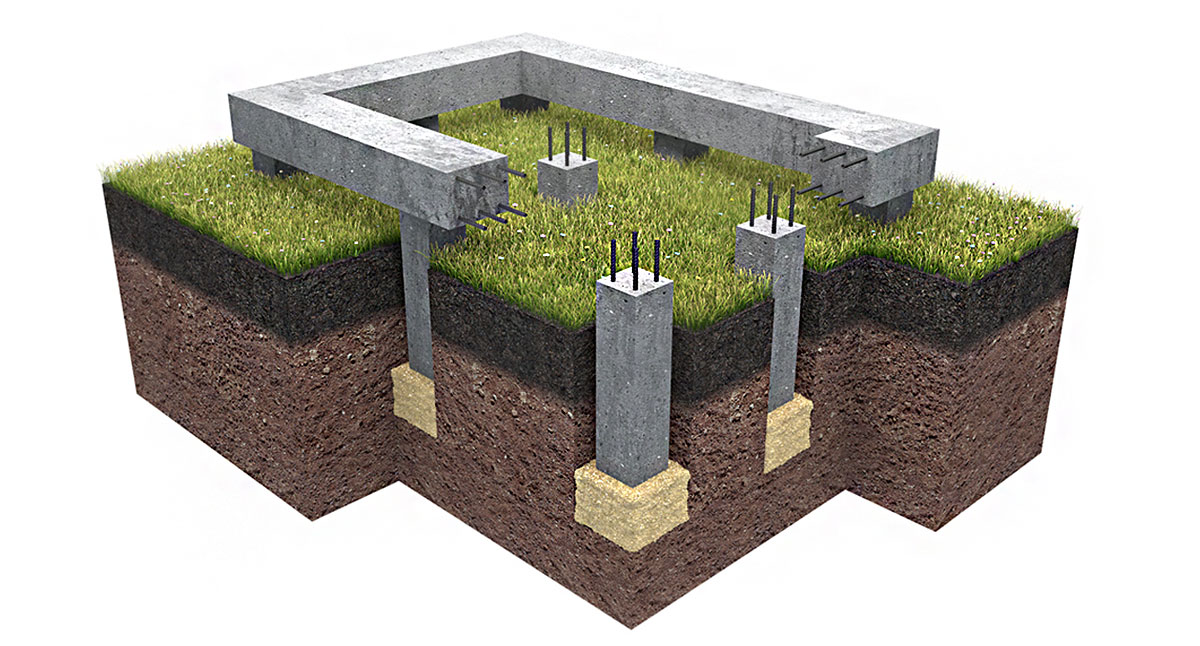
- Foundation footings
- Foundation slab
Deep foundations
Used when the soil has poor bearing capacity.
- Piles
- Drilled piles
Strip foundations
Strip foundations are made under load-bearing walls.
Dimensions:
- Width: 40 – 80 cm
- Depth: 80 – 120 cm
Price:
- 150 – 250 KM/m³ of concrete
- Total: 80 – 150 KM/m² of foundation
Foundation slab
A foundation slab is a reinforced concrete slab that covers the entire surface of the object.
- Thickness: 15 – 30 cm
- Price: 120 – 200 KM/m²
This type of foundation provides even load distribution and is ideal for weaker soils.
Soil bearing capacity
Soil bearing capacity determines how much load the soil can withstand.
- Gravel: high bearing capacity
- Clay: medium
- Sand: varies
Geomechanical testing of the soil is mandatory before construction.
Reinforcement in foundations
Reinforcement gives strength to concrete.
- Rods: Ø10 – Ø16 mm
- Mesh
Price of reinforcement:
- 1.5 – 2.5 KM/kg
Concreting of foundations
Concrete must be properly installed and vibrated.
- Concrete MB20 – MB30
- Price: 150 – 250 KM/m³
Hydroinsulation of foundations
Protection from moisture is key.
- Bitumen strips
- Coatings
Price: 10 – 25 KM/m²
Thermal insulation of foundations
XPS is used due to its resistance to moisture.
- Thickness: 5 – 10 cm
- Price: 60 – 100 KM/m²
Most common mistakes
- Insufficient depth
- Poor reinforcement
- Low-quality concrete
- Lack of hydroinsulation
Total cost of house foundations (150 m²)
- Excavation: 2,000 – 4,000 KM
- Concrete: 6,000 – 10,000 KM
- Reinforcement: 4,000 – 7,000 KM
- Labor: 3,000 – 6,000 KM
Total: 15,000 – 27,000 KM
Return on investment
High-quality foundations reduce maintenance costs and increase the durability of the object.
Implementation tips
- Always perform geomechanics
- Do not save on reinforcement
- Control the quality of concrete
Conclusion
Foundations are the basis of every building. Their proper execution guarantees the safety and longevity of the object. Investing in quality foundations is the most important investment in building a house.