Permanent loads are those that are likely to act on the structure throughout its lifetime or have a change in intensity, but these changes are negligible compared to the average value. Permanent actions include: self-weight, fixed equipment (additional permanent), soil pressure, water pressure, prestressing, settlement of supports, deformations due to the construction method of the structure.
The most important permanent load is the self-weight of the structure. The self-weight of building elements is classified as a permanent action and as a non-moving action. It is always a limiting factor for achieving the largest possible spans. In this case, the decisive factor is the ratio of material strength to specific weight.
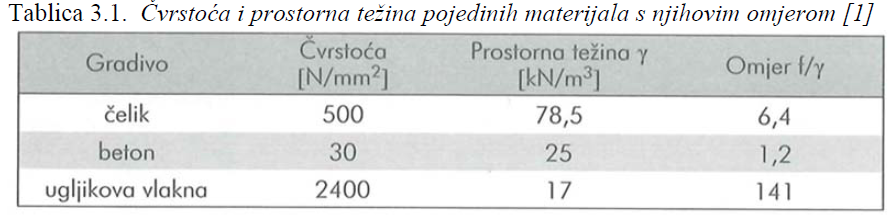
From the table, it can be seen that steel structures, despite having a greater volume weight, due to their much greater strength for large spans, are more suitable than concrete structures.
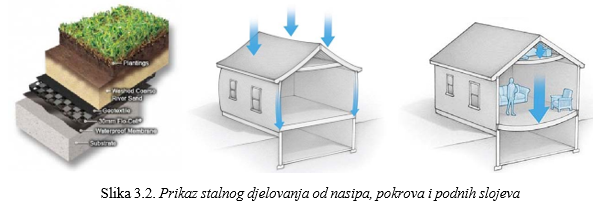
Other components of permanent load (Figure 3.2) related to the purpose of the building are:
- various embankments
- coatings
- floor layers
- insulations
- roof coatings
- plaster
- fixed partition walls and others.
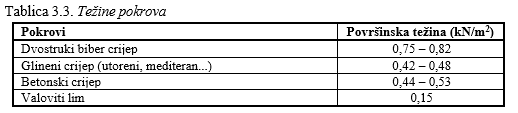
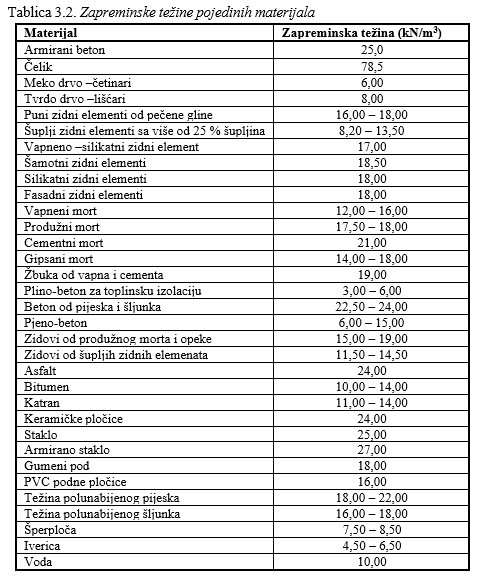
An example of determining the weight of stationary machines, electrical equipment, and cladding is included in the self-weight, as well as the weight of the earth, insulation, or awning. Equipment whose position is not exactly defined at the time of design or, for example, movable partition walls, can be taken into account in the calculation as a uniformly distributed load. The values of the substitute continuous load are best estimated based on experience, with a reasonable approach by the designer. A minimum value of 1.0 kN/m2 is used for rooms with standard partition walls and floor heights. Also, the weights of roofs due to the more complex geometry of individual elements (waviness) are usually taken as a substitute surface load, such as the values given in Table 3.3.
For steel structures, the characteristic self-weight should be determined as the product of the sum of the nominal weights of individual elements and the coefficient k = 1.1, to take into account the plates and connecting media in the nodes