





Settlement of the foundation soil under the load of a building can be uniform or non-uniform. Uniform settlement can cause problems only with large amounts of settlement and that of an operational nature, in a way that it leads to the sinking of entrance doors, changes in drainage slope, and damage to infrastructure installations such as sewer pipes, etc. Large uniform settlements are rare occurrences and are associated exclusively with construction on poor foundation soil.
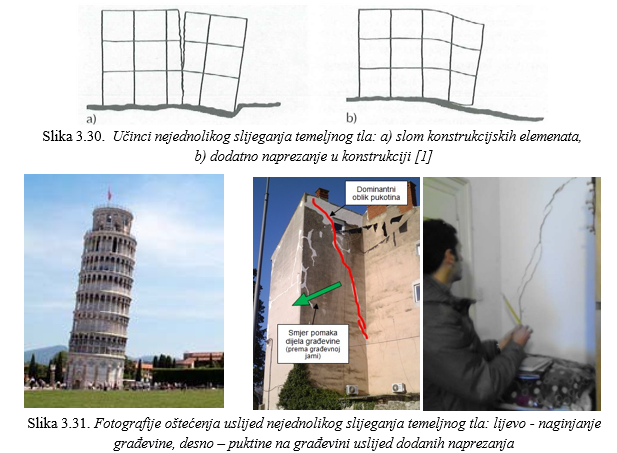
Non-uniform settlement (Figure 3.30) is a more frequent phenomenon that can cause more serious problems in the structure. Such settlements can cause tilting of the load-bearing structure and the entire building, as well as additional stresses in the structure that can result in damage or even failure of individual structural elements (Figure 3.31).
The effect of uneven settlement on a structural element can be clearly seen from the analysis of internal forces (bending moment) of a continuous beam over two spans (Figure 3.32). If such a beam is loaded with a uniform continuous load q, the largest bending moment in the field is Mfield = 0.09⸱q⸱l2. In the event of significant settlement of the middle support, the beam will be supported on the two end supports and will behave like a simple beam on a twice larger span, and in that case, the bending moment in the field will be Mfield = 0.50⸱q⸱l2. Looking at the increase in moment, it is more than five times, and what's worse, this is now the maximum bending moment in the field in the event of support failure, at the point where the maximum moment was above the bearing when all three supports were in place.

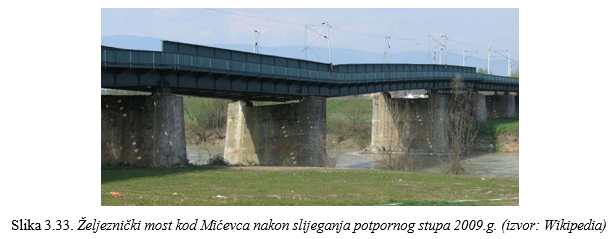
Given that this is an extreme situation, it can be seen how much of an impact uneven settlement has on structural elements and how easily it can lead to the collapse of a structural element and major damage, as shown in figure 3.33.
Differential settlement must certainly be taken into account during design, especially for statically indeterminate structures, as the effect of differential settlement is much greater in them than in statically determined systems. Therefore, it is extremely important during design to have data on the soil and its settlement, which are obtained through investigative work in the soil and the creation of a geotechnical report. The geotechnical report provides data on the permissible load on the foundation soil and the size of the expected settlements, whether uniform or differential. Therefore, it is important that the geotechnical report is available during the creation of the conceptual solution and project, and not done afterwards, as this can significantly disrupt the design and construction process, either resulting in more significant changes to the solution of the load-bearing structure or determining that it is necessary to abandon the construction of the building at the selected location.