





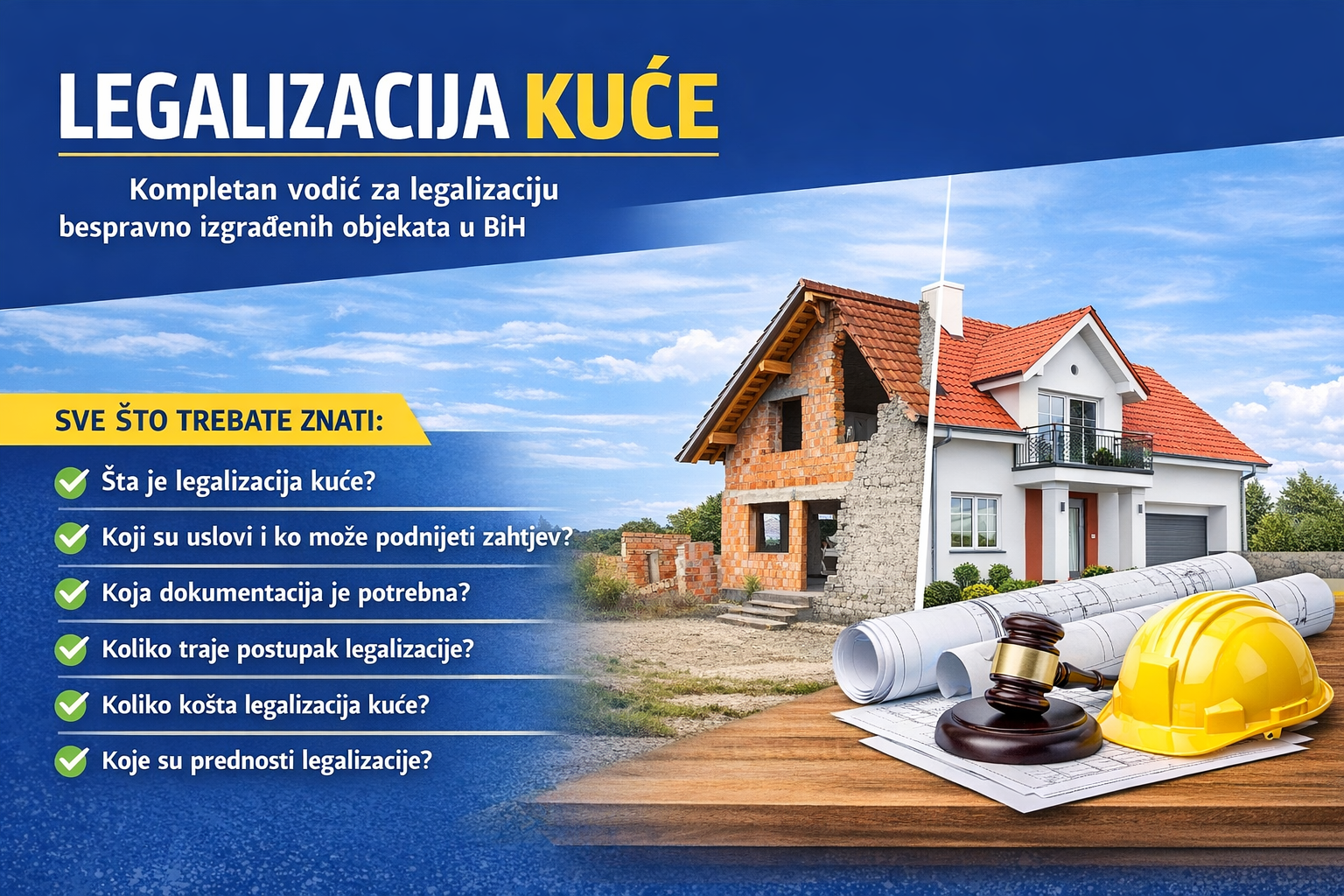
House Legalization, Building, Object, Weekend House, etc. is a process by which an illegally constructed object or part of an object is subsequently aligned with current laws, spatial plans, and technical standards. In Bosnia and Herzegovina, a large number of family houses, weekend houses, and auxiliary objects were built without complete documentation, which creates serious legal and financial obstacles for owners.
If you own a house without a building permit, with an unregistered floor, extension, or deviation from the project – this guide will explain to you:
What house legalization entails exactly
What the legal requirements are
What documentation is required
How long the procedure lasts
What the costs are
What the risks are
How to avoid rejection of the application
1. WHAT IS HOUSE LEGALIZATION?
House legalization is an administrative process by which the competent authority (municipality, city, or canton) determines whether an illegally constructed object can remain in its current state and whether it meets urban, technical, and safety criteria.
A house is considered illegal if:
it does not have a building permit
it was not built according to an approved project
it has additional structures built without permission
it is not registered in the cadastre and land books
After successful house legalization, the owner receives a decision on legalization that allows:
✔ Registration of the object in the land books
✔ Unrestricted disposal of the property
✔ Possibility of sale or gift
✔ Possibility of obtaining a mortgage loan
✔ Increase in market value
Without legalization, the house does not legally exist in full capacity.
2. WHY IS HOUSE LEGALIZATION IMPORTANT?
Many owners live in houses that are not legally regulated for years, thinking that it does not pose a problem to them. However, problems arise when:
they want to sell the house
they want to transfer ownership to their children
they want to take out a loan
an inspection occurs
an inheritance procedure occurs
A house without legalization:
Has a lower market value
Is difficult to sell
Cannot be the subject of a bank mortgage
Can be the subject of inspection penalties
3. LEGAL FRAMEWORK FOR HOUSE LEGALIZATION IN BIH
Bosnia and Herzegovina has a complex administrative system. Regulations on house legalization differ by entities, cantons, and municipalities.
Conditions usually include:
The object must have been built before a certain legal deadline
It must not be on public property
It must be in accordance with spatial-planning documentation
It must meet minimum safety standards
It is essential to note that each municipality has its own bylaws and decisions, so the details of the procedure may vary.
4. WHO CAN SUBMIT A REQUEST FOR HOUSE LEGALIZATION?
A request for house legalization can be submitted by:
The landowner
Co-owner with the consent of the other co-owners
Heir
Investor with proof of the right to build
In cases of unresolved property-legal relationships, the procedure can be complicated, but it is not always impossible.
5. WHAT DOCUMENTATION IS REQUIRED FOR HOUSE LEGALIZATION?
The most commonly required documentation includes (depending on the municipality):
Request for legalization
Proof of ownership (Land Registry excerpt)
Copy of the cadastral plan
Geodetic survey of the actual state
Project of the existing state
Photographs of the object
Proof of payment of administrative fees
- Consent of the utility companies (main project)
In special cases, the following may be required:
Energy certificate
Others
6. HOUSE LEGALIZATION PROCEDURE – STEP BY STEP
6.1. Checking Urban Planning Compliance
The first step is to check if the object complies with the valid regulation plan. If the house has excessive height or is too close to the neighboring parcel, problems may arise.
6.2. Geodetic Elaborate
An authorized geometer goes to the site and makes a precise survey of the object.
6.3. Preparation of the Project of the Existing State (Concept, then Main Project of Legalization)
The designer prepares documentation that shows the real state of the house:
Floor plan of all floors
Cross-sections
Façades
Construction
Areas
This document is crucial in the house legalization procedure.
6.4. Submitting the Request
The complete documentation is submitted to the competent authority.
6.5. Administrative Processing
The authority checks the documentation, possibly requests additional information, and makes a decision (subsequent urban planning approval and then subsequent building permit).
7. HOW LONG DOES HOUSE LEGALIZATION TAKE?
The duration depends on:
The completeness of the documentation
The workload of the municipality
The complexity of the object
The need for additional approvals
Average duration: 2–6 months.
Complex cases can take longer.
8. HOW MUCH DOES HOUSE LEGALIZATION COST?
The costs of house legalization include:
Geodetic survey
Project documentation
Administrative fees
Fees for regulating the building land
Possible communal fees
The price depends on the square footage, location, and complexity of the object.
Smaller houses have lower costs, while larger houses and objects with multiple floors require more detailed documentation and higher fees.
9. CAN EVERY HOUSE BE LEGALIZED?
No.
House legalization is not possible if the object:
Is built on public property
Is on a landslide
Is in a protected area
Is in complete contradiction with the spatial plan
- Others
In such cases, it may be ordered to demolish part or all of the object.
10. LEGALIZATION OF THE ADDED FLOOR
A frequent case is the extension of a floor without permission. Legalization is possible if:
The floor does not exceed the permitted number of floors
The structure meets safety requirements
Does not endanger neighboring buildings
11. LEGALIZATION OF AUXILIARY FACILITIES
Garages, storage rooms, summer kitchens and sheds are often not registered. All “permanent” facilities must be included in the legalization process of the house.
12. LEGALIZATION OF THE HOUSE BEFORE SALE
If you plan to sell, the legalization of the house is almost mandatory.
Customers today are looking for:
Nice papers
Entry in the land register
Credit availability
A legalized house fetches a higher price and sells faster.
13. MOST COMMON ERRORS IN THE LEGALIZATION PROCEDURE
Incomplete documentation
Incorrectly prepared project
Engaging unauthorized persons
Ignoring urban planning restrictions
Delays in supplementing documentation
Errors prolong the procedure and increase costs.
14. ADVANTAGES OF HOUSE LEGALIZATION
✔ Legal security
✔ Higher market value
✔ Possibility of credit
✔ Peaceful disposal of assets
✔ Protection against inspection measures
Legalizing a house is an investment in a secure future.
15. IS IT PAYABLE TO LEGALIZE THE HOUSE?
Absolutely yes.
The cost of legalization is significantly lower than:
Loss of property value
Unable to sell
Potential penalties
Problems in the inheritance process
A legalized house is a safer and more valuable asset in the long run.
CONCLUSION
Legalization of house, building, facility, cottage, etc. is a process that brings complete legal certainty to the owner. Although it can seem administratively complex, with proper documentation and professional support, the procedure can be completed successfully.
If you have a house without a building permit, with an unregistered floor or extension – it is best to start the process as soon as possible.
Legalizing a house means:
Security
Higher value
Easier sale
Peaceful ownership
We offer the above service, contact us.